Monday, 20 February 2017

Shame and Prejudice: A Story of Resilience

Kent Monkman
Canada is celebrating its 150th birthday this year.  A quick look on-line, shows hundreds of celebratory events.  Our National Parks are free this year so we can enjoy the beautiful land that we live in.  And there will be fireworks galore.  Back in 2014, Barbara Fischer, the director of the University of Toronto’s Art Museum had her own idea.  She commissioned Cree artist Kent Monkman to create a Canada 150 project.

A lover of art history, Kent and his team searched museums to curate this project.  However, Monkman writes, “I could not think of any history paintings that conveyed or authorized Indigenous experience into the canon of art history…… museums across the continent hold in their collections countless paintings that depict and celebrate the European settler’s expansion and ‘discovery’ of the North American landscape, but very few, if any, historical representations show the dispossession and removal of the First Peoples from their lands.  This version of history excised Indigenous people from art history, effectively white-washing the truth from Canada’s foundational myths and school curriculums.”

And so he created his own paintings using the styles of classical and modern art to fill in the missing pieces of Canada’s visual history.  He recreates and reimagines famous paintings using “humour, parody, and camp” to confront “the devastation of colonialism.”  His alter ego, the “gender-bending time-traveller, Miss Chief Eagle Testikle, “embodies the flawed and playful trickster spirit, teasing out the truths beyond false histories and cruel experiences.” (all quotes from the exhibition Brochure

 One painting called The Daddies  recreates the famous Robert Harris painting of the Fathers of Confederation.  However, in Monkman’s rendition, Miss Chief sits naked before the Fathers wondering how to get a seat at the “table”.  In an interview with Metro News, Monkman says, “There was no thought towards Indigenous people in that meeting.”


The Daddies, Kent Monkman (photo Globe and Mail)

As I walked through the exhibit, I saw images that dealt with sexual exploitation, murdered and missing Indigenous women, addiction, the slaughter of the bison, treaties and the fur trade.  Eventually I wandered into a small room painted in blackboard paint.  At the far end, brilliantly lit, was a painting called The Scream (after the famous painting by Edvard Munch).  The painting depicted Mounties, nuns and priests dragging children away from their parents to take them to residential school.  It is painful and heart wrenching to see the faces of the children and parents who are almost life sized.  On the side walls are mounted antique cradle boards found by Monkman and his team, that used to hold babies.  In between the cradle boards are some spaces.  Upon closer inspection, I saw that there were chalk marks outlining cradle boards that were missing.  We all know that chalk marks in movies are used to mark murder scenes so the message was crystal clear and chilling. Monkman, whose grandmother went to residential school, cuts through the rhetoric and touches the very core of this truth of our history.

Kent Monkman with The Scream  photo:Toronto Star

Despite the sad stories from this part of our shared history, Monkman is not telling a deficiency narrative.  The exhibition is entitled, Shame and Prejudice: A Story of Resilience.  Just like Jane Austen’s Pride and Prejudice, this show is accompanied by Miss Chief’s journal in nine chapters.  In Chapter VI, Miss Chief writes, “ So many of our people grew up broken – is it any wonder that they fill the prisons, crowd the wards, and line the sidewalks, lost in the cycle of self-loathing, trauma, and addiction?  I shine brightly for these souls through the darkness, slaying savage masculine force with the dazzling power of my beauty and allure.  I am the light, the two-spirited gentle man and fierce woman.  Walk towards me, my children, fall into step and let the drum guide you.  You will be reborn free to rise again with the buffalo.”
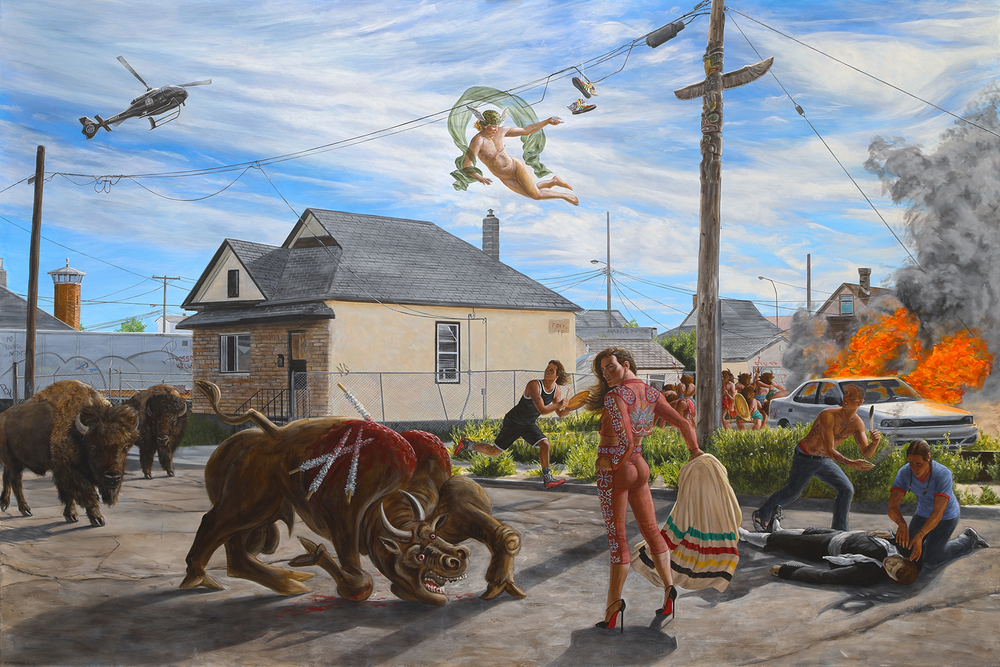
Seeing Red, Kent Monkman
Here in Seeing Red  Miss Chief stands down a Picasso bull with a Hudson’s Bay Blanket instead of a matador’s cape.  The matador lies on the road attended be two Indigenous healers (after Manet’s Dead Toreador).  Monkman writes, “Picasso’s phallic bulls and his butchering of the female nude were contemporatous with the European aggression against the female spirit (homophobia, violence against women) in North American Indigenous societies, many of them matrilineal. ”  In this painting, Miss Chief  takes over the matador`s role as bison return again and people in bison masks dance in the background.

Monkman writes, “I wanted to activate a dialogue about the impact of the last hundred and fifty years of European settler cultures on Indigenous peoples, and about Indigenous resilience in the face of genocide.”  He is sure to succeed in this mission.  The exhibition is filled with images and dioramas that cut through what we thought we knew.  Using visual cues from European art and our own Canadian culture as well as Indigenous images he challenges the colonial mindset.  One has to interact with the art to try to understand the message and this is definitely a decolonizing experience.  One has to make space inside for the new information and space to rearrange the previous pattern set down in our childhoods in history class.  It has been said that we are a country reconciling with our own history and this Canada 150 exhibition helps us to do that.

image: CBC
Shame and Prejudice: A Story of Resilience will be travelling across Canada for the next few years, activating the dialogue that Monkman wants us to have, helping us to re-story our national story and setting Indigenous history firmly in the canon of art history. 

You can find out where the exhibition is, view images and read the brochure with all of Miss Chief`s journal entries and Kent Monkman`s foreword by clicking on these highlighted words.


Monday, 13 February 2017

All That We Are is Story

Author Richard Wagamese
“All that we are is story. From the moment we are born to the time we continue on our spirit journey, we are involved in the creation of the story of our time here. It is what we arrive with. It is all we leave behind. We are not the things we accumulate. We are not the things we deem important. We are story. All of us. What comes to matter then is the creation of the best possible story we can while we’re here; you, me, us, together. When we can do that and we take the time to share those stories with each other, we get bigger inside, we see each other, we recognize our kinship – we change the world, one story at a time…”

Monday, 6 February 2017

Changing the Story from Fear to Love

Disaster and chaos can provide openings for change.  The anti-Muslim rhetoric in the US and the horrible shootings of men praying in a mosque in Quebec last week have disrupted the anti-Muslim rhetoric that Stephen Harper used in the last federal Canadian election.

As Canadians reacted to the US ban on people from seven predominantly Muslim countries which was supposed to protect Americans from ``Islamic terrorists`` the story was turned upside down by a French-Canadian man who committed an act of terrorism on Muslims at prayer. This disrupted the narrative that talked about people in Canada being afraid of Muslim terrorists since this terrorist was non-Muslim.  The story changed to Muslim Canadians who have already been threatened by hate crimes, now being afraid of Canadian terrorists.

Canadian politicians were quick to stand with the Muslim community and distance themselves from the rhetoric that feeds such acts of violence.  On social media, all kinds of Canadians showed support for the Muslim community including donations for the families left behind.  Tens of thousands showed up for vigils and gatherings in the days that followed..  The CBC website listed acts if kindness following the attack. For instance, Grace United Church in Dartmouth which recently sponsored a Syrian family changed their sign to read: “We preach love and respect for all.  Today we are Muslim.”  Someone else left roses and a condolence card outside of a mosque in Dorval, Quebec. which has been threatened in the past.  A Toronto high school teacher asked his class to write letters to the local Islamic  Information and Dawah Centre.  Grade 4 students at the elementary school in St. Foy near the mosque where the attack took place placed cards in the snow outside under a banner which read “All United”.  And a Muslim-Jewish couple set up a Go Fund Me page to raise money for the families.

On Friday, there were remembrance ceremonies and prayers in mosques all across Canada to which people of all faiths were invited.  People that had never been in a mosque before attended and were warmly welcomed. On the website of the mosque in the city where I live, was posted a thank you message.  It read:  "Thank you all again.  We are deeply touched!  Visitation on Friday Feb. 3, 2017 by so many persons/organizations whom we knew before and those not known before.  This affirms the Unity, Care & Unconditional Support of our Community of Barrie/Simcoe at large."


in Toronto, Rabbi Yael Splansky organized “rings of peace” where Jewish and Christian congregations physically surrounded six Toronto area mosques so that those inside would feel safe while they prayed on the first Friday since the attack.  She got the idea from about a thousand Muslims who surrounded an Oslo synagogue which such a “ring of peace” in 2015 following a string of anti-Semitic attacks in Europe. You can see pictures of the Toronto ring here

The need for sympathy to turn into action was highlighted in call-in-shows following the tragedy.  The importance of educators in educating themselves and their students about respect for all people was repeated.  

On the Tuesday following the massacre, I read in the Metro newspaper, advice from Amal Rona, a Vancouver based Musilim poet, educator and community organizer on three practical ways to ``show you won`t stand for Islamophobia – that you care.``  Entitled Be a Good Neighbour, she recommended: 

                 Ask – Across the country, it`s time to start `hard conversations`around              dinner tables and in classrooms.  Talk one-on-one about the real-life                  experience of Islamophobia and the negative stereotypes people hold                about Islam.
          Create Safety – Talk to local business owners about making your                      neighbourhood coffee shop, corner store or restaurant into a "safer zone"          where people know they can take shelter if they’re feeling harassed..                               Check in – Look in on your Muslin neighbours and see if there`s anything        they need: some company, a walk to school or work, or a hand with the            kids.  This week of terrible news has been deeply traumatic Rana said,              and trauma tends to be isolating.  Being a friend can lighten the load.

I also saw on facebook, a post called A Bystanders Guide to Standing up Against Islamophobic Harassment (And Other Types of Harassment, Too) by Maddy Mers.  You can view it here.


It basically describes what to do if you witnessed a man being verbally abusive to a woman wearing a hijab on the bus or subway.  Maddy recommends going to sit beside the woman and say hello, trying to look calm.  Then start talking about a random subject such as the weather, that you like something they`re wearing, etc.  Keep eye contact with the woman and ignore the attacker the whole time.  A lack of response will encourage him to go away.  Stay with the woman until the attacker leaves and then escort her to a safe place.

I heard over and over again that although there are some individuals who do not want to live peacefully with their neighbours, the majority of people do want to live in communities that show respect, understanding that we are stronger because of our differences.  It really seems to be a time when this majority needs to not only speak up, but to show in actions that this is true.  The steps that many of us took this week can be followed by others.  As we empower ourselves to live our truth, our communities will be stronger, more loving and open for all of us.  This could be our chance to tell a new story.

Monday, 30 January 2017

Love Trumps Hate

On the day of the inauguration of America’s 45th president, I had some cancellations from my clients due to illness, travel and personal reasons.  And so I left work 3 hours early.  I caught a commuter bus just after lunch and planned to go to my northern office on the way home to do a little paper work and then go to the bank before going home to pack for the weekend and head up north to my weekend home with my partner.


I was sitting on the bus as it travelled north on Highway 400,  listening to a podcast on my iPod when I noticed a woman across the aisle gesturing at me.  She had long curly brown hair, glasses and she looked to be about my age.  I took the ear buds out of my ears and looked at her.  She wanted to know when this bus would get into Barrie since she couldn’t make sense of the schedule.  I told her that I didn’t know because I was getting off before Barrie but I offered to look at the schedule for her.  She handed it across the aisle and as I studied it, I realized that it was not the schedule for the bus we were on.  She told me that she was actually headed to Midland to attend the funeral of the mother of her best friend growing up, who had just passed away.  I asked her how she was going to get to Midland from Barrie as I didn’t know of a bus going there.  She didn’t seem to have a firm plan.  She told me that she felt going to the funeral was the right thing to do and she had decided to do it and then just set off.

 I was going to get off the bus part way to Barrie and then drive there myself to pack up and then head up north to Waubaushene, near Midland.  And so, I explained this to her and offered to drive her if she would like that.  After considering this briefly she accepted my offer.  She seemed so intent on doing the right thing that I was willing to help her in this mission.

We had to get off the bus a few minutes later and she gathered her coat and two bags and followed me off the bus.  Just as we reached my car, she realized that she had left her knapsack on the bus.  She ran towards the bus which had pulled away and we watched it turn onto the highway towards Newmarket.  I told her to get in my car because  I knew where the bus was going and I knew that I could catch it.  We would simply follow it for ten minutes to the GO terminal where she could retrieve her knapsack.  And so off we drove.  It felt like being in a funny movie at this point and I was curious to see how the story would play out.

I soon caught sight of the bus and pulled into the parking lot at the terminal as the bus swung into the bus lane there.  I pulled up by a gate and my new travelling companion, Mary jumped out of the car and ran into the line of parked buses.  A few minutes later she reappeared, backpack in hand, scanning the lot for my car.  I waved at her and she came to my car and got in.

Then we retraced our journey back to the highway.  We found lots of things in common to talk about as we travelled.  She had taken a course in a building next to my office in Toronto on mindfulness meditation.  I knew something about that and we shared our experiences with it.  We told each other stories from our lives, just like people do in road trip movies.

Arriving in Barrie, we stopped at my home and she came inside while I packed up.  She noticed things about my home such as my paintings and the cat box by the back door.  I had recently discovered it deep in a closet even though my cat had passed away last summer.  So that gave us more things to talk about as we headed to Midland.  The closer to Midland we got, the more stories she told me about her childhood growing up in Penetanguishene to the north of Midland.  It turned out that I had played music with a person who she had failed grade 3 with. 

Mary told me that the friend she was going to stay with lived in Penetanguishene so I headed there after going through Midland.  Pulling into that small town, she guided me past the Anglican church that her father had been the minister at, past the house she grew up in and the house next door that the deceased women had lived in.  We drove down Church Street in search of the house that the friend she was staying with lived in, looking for the landmark of a turquoise garage door.  We nearly missed it as the garage door was up, but Mary noticed the same shade of turquoise on the posts on the front porch.  I pulled into the driveway and opened the trunk for her, making sure she had all her bags this time.  She thanked me for the drive and we said goodbye.

As I was about to leave Penetanguishene, it occurred to me that I have a friend who lives there who might be at home.  And so I dropped by her house and she invited me in.  We had tea and a visit and caught up on the details of our lives.  She laughed at my road trip story.  And then I drove to my partner’s home in Waubaushene and told him the story of my afternoon.  He laughed too and said that he would have given a ride to Mary as well.

The next day was Saturday and I followed the news of the Women’s March.  News of the huge crowd of a half million in Washington and sister marches in other US cities, 30 communities in Canada as well as 600 other marches on all seven continents of the world emerged on the radio and internet.  Apparently even in Antarctica there were people who marched.  I bought a newspaper the next day to get pictures from the marches and the total count.  It was estimated that 2 million women and men marched in support of the rights of women, LGTBQ people, the disabled, workers, environmental justice and the rights of all human beings in opposition to the president’s twittered proclamations.  I was surprised that women all over the world would march in support of American women since many countries don’t like the US. 

But then it dawned on me that these women were seeing past nationalities and really standing up for what they believe; the rights for all people.  It also occurred to me that my time spent with Mary the day before was the same thing; helping a stranger do what she felt was the right thing.  Joining forces to support someone who had just lost her mother.  It’s just what we do.

In the following week, amidst shocking presidential executive orders, emerged stories of other doing the same.  A minister in the Netherlands’ government had gained the support of 20 countries to cover the $600 million shortfall for women’s health in the developing world, after the US withdrew it from organizations that offer abortions to women.  Canada’s Minister of International Development, Marie-Claude Bibeau was clear that Canada would participate in this initiative.  The Minister of Public Safety in Canada, Ralph Goodale stated clearly that torture is illegal in Canada and in all international agreements including the Geneva Convention and that there would be compromise on that, even though the president was all for it.  

West Jet airline waived cancellation fees for people who were suddenly denied entry into the US because they were from one of 7 countries that have now been barred from entering the US.  The Canadian government said that Canada would welcome anyone who was stranded by this new ban.  Apparently there were protests at airports in the US and Democrat politicians came to help those who were impacted.  A law firm in the US that has offered pro bono legal help to those affected were swamped with thousands of calls.  Other people have been working long hours to download US government info from the internet on Climate Change so that it can’t be destroyed by the new government.  I’m sure there have been more stories but so far those are the ones that I have heard.


My partner reminded me that there may be one big bully but there are millions and millions of good people as well.  And we need to remember that and be those good people and make our story bigger than the one that currently dominates the media.  


There were many clever and amusing signs at the Women’s March but the one that spoke to this story read,”Love Trumps Hate.”  It is important to remember that and not get swept up in the fear and hate that is creating so much confusion.  It is important to remember who we are and the story we have to tell.


Friday, 20 January 2017

How the Stories We Tell Change our Lives


“We are all storytellers,” writes Emily Esfahani Smith in her book The Power of Meaning: Crafting a Life That Matters (2017).  She goes on to say, “storytelling is how we make sense of our experiences and our identities.”   Narratives help us to put all the pieces of our experiences together into a unified whole that gives our lives meaning.

When we tell our stories, we make narrative choices and so the same experience could be talked about in many ways.  Smith cites psychologist Dan McAdams’ three decades of work in this field.  His research has found that people who tell stories that go from bad to good, what he calls “redemptive” stories, tend to contribute to society and look ahead for future generations.  In contrast, people who tell stories that go from good to bad, what McAdams calls “contamination” stories are less driven to contribute to society and younger people.  People who tell contamination stories are also more likely to be anxious or depressed and feel that their lives are less coherent than people who tell redemptive stories.  In the field of Narrative Therapy, therapists help clients to change how a story is told in order to gain more meaning and a sense of control over their lives. You can read more about this in an excerpt from The Power of Meaning at TED Ideas here.


I came across an example of this recently while listening to someone tell the story of their trip back from a holiday.  The speaker related three incidents that were near misses of disaster and then summed the story up by saying,” I wonder if there is a message there, with all those bad things happening?”  Her story went from a good holiday to bad things happening.  From my vantage point as the listener, it seemed to me that she had gone from bad things happening to a good outcome of no residual harm.  Some would have said that she had lucky escapes but she felt unlucky for coming so close to harm.  She felt anxious that maybe more bad things were on their way while I thought that maybe worrying wouldn`t be useful because bad things can happen and you can still be okay.

I was still thinking about these two kinds of narratives when I came across an article in the Toronto Metro newspaper about bike stands in the Bloordale district of Toronto.  Recently the Toronto City Council after much lobbying by local bicycle advocacy groups and groups like the David Suzuki Foundation, has created an experimental bike lane on the busy main artery of Bloor Street.  There has been a debate among business owners about how this will affect them.  Some say that if people can’t park their cars, their business will be affected negatively.  Others say that people on bicycles are more likely to stop and shop thus affecting some businesses positively.  In the midst of this experiment, a collaboration between the local business association and local students has created a new story.


Students from Bloor Collegiate Institute designed twenty, one-of-a-kind bike stands after researching the history of the area. For example, one student discovered that there used to be a circus located where Dufferin mall now stands.  Pictures of elephants parading along the street inspired the student to put an elephant on the bike stand. 

All twenty stands are related to a historical story of the area. Some of them are pictured here.  The stands were built by Jacqueline Fernandez, a grade 12 student at Contact Alternative School, out of rolled plate and flat bar steel.  The Bloordale business association funded the project.  Originally the idea came from someone who saw bike racks in other parts of the city that were painted in beautiful colours.


These bike stands tell many stories.  They tell stories of the past.  They tell the story of collaboration in the present.  They tell the story of a society transitioning through different modes of transportation.  The stands make it possible for people on bikes to feel welcomed since they have somewhere to lock their bikes up which can be surprisingly hard to find when a lot of people are biking.  They are also making a political point that the businesses are welcoming people on bikes and supporting bike culture instead of telling the angry narrative of what has been dubbed, the “war on cars”.  And the artwork makes them attractive, bringing beauty to a busy urban street.   

The students reached back into the past for good stories to tell today and into the future and they are taking an active part in shaping their community.  I can see how this kind of storytelling will be good for society and for future generations.  It is one of our new stories.

Sunday, 15 January 2017

Raven Reshapes and Transforms the World

RAVEN (Respecting Aboriginal Values and Environmental Needs) is a ” non-profit charitable organization that provides financial resources to assist Aboriginal Nations within Canada in lawfully forcing industrial development to be reconciled with their traditional ways of life, and in a manner that addresses global warming or other ecological sustainability challengers.”

Their small staff is situated in Victoria BC on unceded Lekwungen and Coast Salish traditional territories.  RAVEN’s vision for Canada is”a country that embraces the ancestral laws of Indigenous Peoples and their equitable access to the justice system within a thriving natural habitat.”
RAVEN does this by raising legal defense funds to assist First Nations in expensive legal battles to “enforce their rights and title to protect their traditional territories.”  This levels the playing field against corporations with deep pockets who are often supported by provincial and federal governments.
RAVEN works in collaboration with Indigenous Peoples to provide public education programs to foster a greater understanding of indigenous rights and governance.
In December, I got an email that celebrated the successes of 2016.  This colourful graphic captures the spirit of their work and so I share it here with you.

In January I got an email saying that their year-end fund raising campaign had been responded to by over 350 people in the amount of $48,000.  In addition to this the 100 member Circle of Allies who give monthly ongoing support for their core programs had been joined by 45 more people.
RAVEN has ambitious goals for 2017.  The email reads:
“This year we’re taking on some major challenges. We’ve committed to raise $250k to help First Nations in the Peel Watershed take on the Yukon Government. We’re joining forces with northerners to stand up to Petronas in a campaign to protect wild salmon. Together with five First Nations, we intend to help them stop the TransMountain pipeline and tankers project by launching Pull Together: the People vs. Kinder Morgan. Our initial goal? $500,000.“
This is how thousands of non-Indigenous Canadians are putting reconciliation into meaningful action, by standing with Indigenous people who are protecting the land that we all share. 

Northwest Coast First Nations tell the story of the Raven who stole the light from an old man who had locked it in a box to keep it for himself.  Raven went into the dark and tricked the giant into giving him the light and then this trickster shared it with the whole world.

In one RAVEN email,  supporters were likened to this raven who was "wiling to face down some very dark places -- only to bring forth the light."  This ancient story is being retold right now, in a new way.

Saturday, 7 January 2017

Home to Me

60 Canadian authors posted pictures of their feet
at hashtag standwithgrasssy
In December I received an email from the David Suzuki Foundation about cleaning up the mercury contamination at Grassy Narrows.  A pulp and paper mill dumped ten tonnes of mercury into the Wabigoon watershed in Ontario in the 1960`s contaminating the fish and thereby poisoning members of the Grassy Narrows First Nations.  Fifty years later, it has still not been cleaned up. 

The Ontario government has recently promised to clean up the water but are taking no action.  So the David Suzuki Foundation in the Stand with Grassy Narrows campaign was asking people to join sixty authors and email the premier of Ontario and the prime minister of Canada to tell them that they would stand with the people of Grassy Narrows "until the Wabigoon watershed is clean and safe for their families, culture and economy."

On the same day, I came across a video (view it here) on my daughter`s facebook page, of youth from the Grassy Narrows community performing a song that they wrote about where they lived entitled, Home to Me.  I watched it and was so impressed that I wanted to know more about how they came to make this video.


After doing some research, I discovered that the video was produced by a unique group called N`we Jinan Artists .  This group brings a mobile recording studio and video production team to schools and youth centres in First Nations communities across Canada.  The youth are helped to write a song about issues such as cultural identity, language, struggle, love and self-acceptance.  The values of "positive messaging, community engagement and collective voice” are stressed.

During the process, the youth learn about sound recording, music production, songwriting, voice and performance.  N`we Jinan wants to help the participants develop stronger self-esteem and confidence by "creating a space where participants feel safe, accepted and respected for their ideas."  By learning the skills for musical expression, the community is given a voice and is empowered. The videos are posted on-line and can be watched and shared on social media.  In fact, this video has gone viral with over 98,000 views on youtube and nearly 1,165,000 views on Facebook since its release in March 2016.
 
Youth from Grassy Narrows at the River Run Rally in Toronto

In October of 2016, members of the Grassy Narrows community joined hundreds of concerned citizens at Queen`s Park in Toronto to pressure the Ontario government to take the long overdue action to clean up the water.  The youth group that wrote Home to Me performed at the River Run Rally.  You can see a video of that here.  You can see how much courage it took for the kids from a northern community to perform in front of so many people and also how powerful music can be to empower, inspire and connect people.


N`we Jinan is a collaborative project of the Cree Nation Youth Council and is headquartered in Montreal, PQ.  They are on tour, visiting First Nations across Canada.  When David Hodge and Josh Iserhoff arrived at Asubpeechoseewagong First Nation (Grassy Narrows) which is about two and a half hours north of Kenora to work with the youth and to shoot a music video the temperature was -35 degrees Celsius.  But they completed the project in just three days.

Darwin Fobister, one of the 19-year-old youth in the video says, "We are getting heard and that`s one way we are dealing with these issues, because the more media we do, the more we get heard.  And we need more people to hear our stories about why we love our home and what we need for support." Their song is in English and Anishinaabemowin which is important to the community, to keep the language and culture alive.  Home to Me  is “Gete Ishkonigan,” in Anishinaabemowin.  One of the lines from Home to Me is, “Rise from the ruins, keep protecting the land; don`t take it for granted, can`t neglect what we have.

When I receive requests to write letters or sign on-line petitions, the issues can feel abstract and hard to imagine.  But watching these young people sing the song they wrote from their hearts, touched my heart.  This is their home, not some abstract cause.  Of course they want to protect and heal their home, we all do.  They have used their voices, telling us what they need and asking for support.  We can listen to their voices and join ours with theirs.  This would be a new story.