Wednesday, 7 July 2021

Healing Ceremonies Open to All


We moved together like a long orange snake undulating down the hill towards the lake.  Elders, adults, children and babies dressed in orange shirts and masks, socially distanced into groups but hearts beating together as the leader drummed his hand drum.  The hill had one switchback that created a moving curve in the orange speckled serpentine body.  I was near the back of the procession so I could view most of it from above.  

The snake of people became a curved line as we reached the shore of Little Lake.  The drummer led us into formation, standing side by side along the edge of the beach, facing the lake.  The sky was pigeon grey and the low misty clouds softly released tiny drops of rain.  After weeks of drought, it felt like the sky was crying.  The tears landing on us were somehow comforting as if the sky was wrapping itself around us.  The drummer and his child moved to the edge of the grey water.  Facing us, he sang and drummed.  The song was haunting, painful, and strong.  He sang for all of us, Indigenous and non-Indigenous.  He sang for the lost children who are being found in graveyards of Indian Residential Schools across Canada.  He sang for our hearts, broken, hurting yet strong as we stood side by side.

“We are Anishinaabe and we go through things together,” said one of the speakers before we started our silent walk to the water.  How gracious they were to allow we non-Indigenous people to join them and stand with them, we descendants of the perpetrators of genocide, to be part of the moving body of people.  How generous to share their hard gained knowledge of how to survive terrible times with we, the creators of terrible times.

We each held in our left hands a small Semaa tie, sacred tobacco tied in a square of orange cloth, the carrier of prayers to the Creator.  When the drummer finished, a woman stepped forward holding the hand of a young child.  She untied her Semaa tie and poured the tobacco onto the water.  Then we all stepped forward as one and did likewise.  Hundreds of prayers were offered and accepted by the lake and the Creator.  So powerful was this action that I expected to see a Thunderbird emerge from the low clouds.  I imagined what we must look like from the sky over the water -- a wave of orange stepping forward together.

And then, the snake broke into tiny groups that made their way back up the hill to the parking area and back to homes and families and the rest of life.  The ceremony was planned when 215 graves of children from the Residential School in Kamloops were found.  104 more were located in Brandon, Manitoba and then on the day of the ceremony 751 more at Cowessess First Nation, east of Regina, Saskatchewan.  We know that there are thousands more to come.

In Barrie, Jeff Monague, Elder and Knowledge Keeper from Beausoleil First Nation is holding a Sacred Fire every time an announcement of more unmarked graves is made.  The Sacred Fire is open to everyone to come and take part in this ceremony that last for hours and sometimes days.  People are coming.  Indigenous people and non-Indigenous people, people with children, somehow explaining to their children what this means and how we can begin to heal, together.  You can see it in the faces of the parents of young children.  Little imagination is needed for them to understand what losing a child, children, all the children in the community might mean.  

As more and more Canadians awaken to the truth that has always been known in Indigenous communities, we have a chance to face this truth together and make reparations, apologies, change our thinking, gain respect, earn trust and change how Indigenous people are treated here in Canada.  Ceremony offers a way to heal hearts that are hurting.  There is a place for all of us in this healing.  We all belong to this land and we all belong to this healing.  Each of us has something to contribute.  We are telling a new story, creating it as we go along.  We are the authors of this story.  It is up to us.

Wednesday, 30 June 2021

Hazel: The Ogham Tree of Wisdom

The ancient Celts used the first alphabet in Europe which is called the Ogham script.  Each letter is associated with a tree or an important plant.  The alphabet was used as a mnemonic device to encode knowledge, the Celtic song of the universe, Ceolta na Cruinne (Diana Beresford-Kroeger).  The thirteen months of the year (pre-Gregorian calendar) were each represented by a particular tree.  The new year began on Nov. 1st with Birch, followed by Rowan in December, Alder in January, Willow in February, Ash in March, Hawthorn in April, Oak in May and Holly in June.  The tree associated with July is Hazel.

The Hazel was called Coll and it was represented by the letter "C".

The Hazel tree is a member of the Birch family. It is more of a shrub and can grow up to 6 meters.  It likes damp places but fruits better in well-drained land. The Hazel is common throughout most of Britain, Europe, America, Africa, Turkey and western Asia.  It is found in copses, oak woods and hedgerows.  The bark is smooth, light brown and speckled.  Hazel leaves are small, rounded and heart-shaped with serrated edges. The male catkins swell in early spring with pollen.  They are called “lamb’s tails”.  The female flowers which are found on the same shrubs as the males are small, like stalkless buds.  They stand upright with red styles which look like small crimson brushes.  These threadlike styles catch the pollen and carry it to the seeds hidden inside scaly covered bracts.    These seeds become hard green nuts which turn brown by autumn.  The fruit, the hazel nut is also called filbert or cobnut. It takes 9 years for Hazel trees to make nuts.


Hazelnuts provide food for many small animals such as squirrels and nuthatches as well as for humans.  The hazelnut was a very important source of food for the Celts.

Hazel wood is whitish-red and it has a close, even grain.  Coppicing Hazel was very common.  This was a process in which stems were continually cut from the trees whose spreading roots allowed the tree to send up new long thing stems that were pliable and tough.  This provided an ongoing supply of stems which were used to make hampers, hoops, wattles and baskets.  They have also been used for walking sticks, fishing rods and rustic seats.  Hazel wood makes good artists’ charcoal.  Charcoal for gunpowder was made from Hazel and Willow.

Dwellings called “benders” were made with long hazel poles which were bent and tied in place upon a circular base-frame to form an igloo shape with a tunnel-shaped doorway. The frame was covered in furs, skins, hides, branches, reeds or thatch.

The Celts grew hay with hedgerows of Hazel.  The hay protected the roots of Hazel and the Hazel protected the hay from the wind.  The Greeks used the fresh bark of Hazel to write on.  Hazel was used with willow, cow hides and pine resin to make coracles.

In North America, the Indigenous Peoples used the Beaked Hazel for the fevers of teething.  More recently the medical biochemical paclitaxel has been derived from the Hazel.  This is an anti-proliferation agents that is used to treat cancer.

Scotland's old name Caledonia derives from Caldun or fort of the hazel.  Hazel was used for protection through shields, fences, caps, singed hazel rods, and the carrying of hazelnuts.  In the north of England, the Hazel-tree guardian was called “Meslsh Dick” and in Yorkshire “Chum-milk Peg” (milk-peg is a babytooth.)

Hazel was a chieftain tree under Brehon law and it was the Celtic tree of knowledge and wisdom.  It is the ninth Ogham letter (C) and there are nine sacred hazel trees at the Well of Segais. In Irish legend, salmon were swimming in the River Boyle under the overhanging hazel tree from which the nine nuts of wisdom fell.  These were eaten by the salmon who absorbed the inspiration they encapsulated.  The hazel and the apple were two trees that incurred the death penalty to anyone who felled them illegally.  Scottish legend also had a sacred pool guarded by Hazel trees with two magical salmon. In British folklore, silver snakes lived in hazel roots.  These became the snakes in the caduceus. The caduceus, the symbol of medicine. is made of a hazel wand with 2 twined snakes.  The wings were originally hazel leaves.

Caduceus, the modern symbol of medicine.


The terms “in a nutshell” in which information is contained in a small hazelnut and “thinking cap” are from Hazel as caps were made of hazel twigs to wear in order to gain wisdom.

According to Glennie Kindred, Hazel represents divination, visions, deep listening, intuition, divine source, essence of knowledge, essence of being, wisdom, creativity, transformation, catalyst and the flow.  Hazel connects the conscious mind with the unconscious mind to bring ideas to the surface and transform ideas into reality.  It brings an increase in intuition and inspiration.

According to Colin and Liz Murray, Hazel is associated with meditation and mediation. Hazel represents intuition and the power of divination.  Hazel twigs have traditionally been used for divining because of their pliancy and affinity with water.  These powers of poetry, divination and mediation can be a channel for creative energies especially that which allows you to inspire others.  Hazel allows you to be “a catalyst or transformer, working through the promptings of intuition to bring ideas to the surface.”

Varieties:  The largest Hazel is Turkish Hazel ( Corylus colurna), one variety in Great Britain is Corylus avellana. Two species are native to Canada:  Beaked Hazel (Corylus cornuta) found from BC to Newfoundland and the American Hazelnut (Corylus americana) which is found from southern Manitoba to southwest Quebec.

This is a compilation of information taken from the following sources:

Diana Beresford-Kroeger (2019) To Speak for the Trees. Random House: Canada.

Danu Forest (2014) Celtic Tree Magic: Ogham Lore and Druid Mysteries. Llewellyn Worldwide: Woodbury, Minnesota.

Glennie Kindred, (1997) The Tree Ogham. Glennie Kindred: UK.

Liz and Colin Murray (1988) The Celtic Tree Oracle. Connections Book Publishing: London, UK.

Jacqueline Memory Peterson (1996) Tree Wisdom: The definitive guidebook to the myth, folklore and healing power of Trees. Thorsons: London.

Elen Sentier (2014) Trees of the Goddess. Moon Books: Winchester, UK.


Wednesday, 23 June 2021

The Voices of the Children are Being Heard


Senator Gwen Boniface of Orillia became a Canadian Senator at the same time as Murry Sinclair who was the lead investigator in Canada’s Truth and Reconciliation Commission.  They were both on the Senate’s Aboriginal Peoples Committee.  This work led Boniface to start a Truth and Reconciliation Commission (TRC) Roundtable group made up of Indigenous and non-Indigenous people in the community.  Knowledge Keepers, Elders, clergy, students, people working in education, healthcare, and  policing as well as community members began gathering in the fall of 2019 at first in person and later on zoom getting to know one another and looking for ways to bring the 94 Calls to Action into the community.

It was during these calls that my partner and I heard Indigenous youth talk about all the monuments to the history of the settlers while their own history which is thousands of years old is virtually invisible.  One of the Elders, John Rice spoke about doing something towards reconciliation.  It was shortly after this that the idea for a Land Acknowledgement sign in my little village emerged.  I could picture it in the community garden overlooking the beach on the shore of Georgian Bay.  It seemed like a small project that could be accomplished even during a pandemic. 

I contacted Talpines, the local Property Owners Association to see if their board members would like to partner with me on this idea.  This POA is responsible for getting permission to plant a beautiful garden on the previously bare patch of public ground between the beach and the hiking/cycling trail.  The Board members had questions as to the wording, size and cost of the sign.  I contacted a local Elder, Jeff Monague of Beausoleil First Nation to consult on the wording.  He shared what he currently favoured.  My partner estimated the size of the sign and I offered to pay for it. The board members were enthusiastic about going ahead with this project.  The president of the POA checked with the municipality and found out that we had to get approval from the township council since the sign would be on public land.  We waited to get a space to speak to them.

Months later, we attended a Township Council meeting on zoom and made our submission.  The council were unanimously in favour of the sign and thanked us for bringing the idea forward.  Next, one of the POA members took responsibility for having the sign made based on the design I had in mind.  It took a while to get the finished product due to the ongoing pandemic. 

The sign gets installed.


Finally, the day came when six POA members, my partner and I and a township supervisor gathered at the garden to install the sign.  It was wonderful to see the men working together to dig the hole and position the cedar post.  Everyone was involved in deciding the height of the sign.


And then we all stood back and applauded.  My partner and I shared a few words with the group.  It took seven months from the vision of the sign in my mind to seeing it in the 3D world.  It felt good to have a group of people collaborate on this project which although very small is perhaps a starting point for further projects and inspiration.  The Land Acknowledgement is positioned beside a very busy trail and a beach which will be visited by hundreds and hundreds of people this summer.  Some will read the sign and be reminded to honour the land they are on and the Indigenous people who have cared for it so well for thousands of years.


To the right of the garden is a water pumping building that has a large mural on it.  This mural was painted by the high school students in nearby Midland.  It depicts the animals that represent the Seven Grandfather Teachings of the Anishinaabeg.  A sign by the trail talks about Residential Schools and the Healing Path of the Grandfather Teachings.  There are some stuffed animals tied to the post of the sign to honour the 215 children who were buried anonymously at the Kamloops Indian Residential School.  Another resident has posted signs with orange shirts on them reading “Every Child” along the trail.   Together, all these signs speak a message that is getting louder, a message that all Canadians need to hear.  More of us need to participate in getting this message out.

The animals that represent the Seven Grandfather Teachings, the Healing Path.  Note the orange shirts
in the mural as well.

The poster that explains the mural and the damage done by Indian Residential
Schools along with other memorials.


The Indigenous youth members of the TRC Roundtable wanted to have a Walk for Reconciliation on June 1st in the high schools of Orillia.  Unfortunately, the schools were closed down before this could happen due to COVID restrictions.  However, the older members of the Roundtable decided to create a virtual walk through a website.  In a few short months a beautiful Place for Knowledge or Kikendassogmig was created.  You can check that out here. 

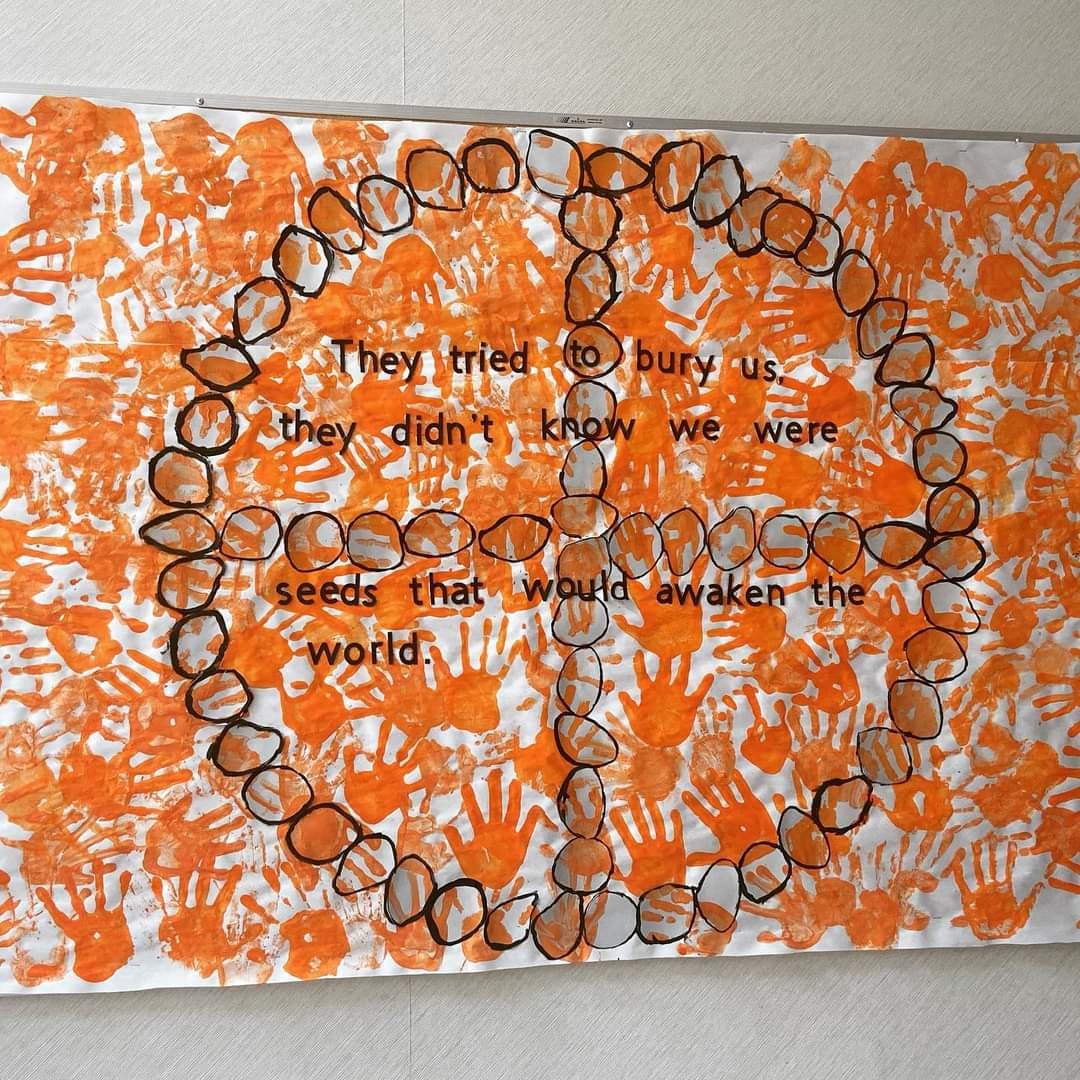
The voices of the children are being heard.  Those children who were lost and those living among us.  This mural from the students at N'kwaka School in Douglas Lake, BC perhaps says it best.

N\kwala School in Douglas Lake, BC


Wednesday, 16 June 2021

Healing Historical Trauma


Trauma therapist and author of My Grandmother’s Hands, Resmaa Menakem talked about trauma being held in the body during an interview on a Conversations in Compassion podcast. (Listen to it here) 

I found his understanding of trauma held in European bodies very interesting.  Menakem explains, “So, when I’m looking at things, I’m looking at the five brutalities, right?  Colonialism, Enslavement, Genocide, Imperialism and Land Theft, right.  And when I look at those five brutalities and I apply those five brutalities to Europe, those things along with public dismemberment… along with rapes, along with Inquisitions … along with the Crusades, along with famine, along with plague, along with… a lot of brutality existed.  And that existed from about 500 AD to approximately 1500 right?”

When I listened to Menakem describe the history of Europe in that way, it surprised me.  On one hand, it felt true.  That is why I never really liked history class in school.  European history, which was taught as the “only history worth talking about” seemed to be a succession of violent incidents.  Wars that lasted a hundred years, plagues, witch trials and horrible tortures. What surprised me was my learned reaction to this violence.  Within myself, I found an attitude of inevitability about how Europeans have behaved, a learned belief that people are basically bad and need to be controlled.  This worldview of course is supported by the churches.  Even though I recognize inner trauma and wounds in people of European descent, I had never really thought about the weight of a thousand years of trauma on genetic codes and epigenetic influences.  I had never really thought about how that may be coded in my body.

Menakem continues, “Then we start moving into the Enlightenment and all these other things, right.  But during that time, you’re talking about a thousand years of elite white bodies destroying less elite whites bodies, right. Destroying people, taking people’s lands, committing genocide.  All of that different type of stuff was happening for a thousand years on that body, right?  And then, in 1492 that body… came… here.”

The problem with being taught from a Euro-centric worldview is that it feels as though all people were the same as the Europeans.  Menakem would call that White Body Supremacy in which the white experience is seen as normative and anything else deviates from the norm.  Listening to Menakem’s voice got me thinking about what exactly I am lugging around in my genes.  The anxiety which my grandmother described as inherited in our family is the first thing that jumped to mind.  The feeling of not belonging, of watching one’s back, of waiting to be whacked (that is the best way I can describe that form of anxiety) and of fearing starvation quickly jumped into view as well.  Feelings that seemed "normal" suddenly became evidence of historical trauma.

Does this trauma carried in white bodies explain why a young man killed a family of Muslims with his truck recently?  Does it explain racism from white people?  I don’t see this idea as an excuse, more of a diagnosis in search of a cure.

Menakem continuea, “And one of the things we know about trauma is that trauma becomes decontextualized and over time can look like culture. And over time can look like family traits. And over time can look like personality. And once that body came here with all that brutality, I believe when they saw the first Indigenous people, no matter how beautiful, how nice, how much these people who wanted to help, no matter how much they did help, that trauma could only see those people as something to be conquered and made into noble savages, right. Made into Christians, because that’s what happened to them, right?”

I have been wondering if the fear of scarcity created by a thousand years of trauma was not healed by the abundance of Turtle Island (North America).  Instead, the fear became greed in the face of abundance and this greed has perpetuated the trauma onto the First Peoples and the land. 

People who are becoming more conscious of the actual history of this land are searching for what they can do to change things.  Learning the true history, writing letters, having conversations with others, standing with Indigenous people in person, building relationships, and advocating for political change are important.  And figuring out how to heal this trauma trapped in white bodies may very well be another important piece. 

I am not saying that I actually know how to do this but reading My Grandmother’s Hands seems like a next step for me.  So I have downloaded the audio book and will see what Resmaa Menakem says about releasing trauma from the body.  I am working on this for my ancestors, for all those yet to come and for myself and those who are here on Earth with me now.  A new story of how we are together is emerging.  I can see the signs and I welcome them as I learn how to heal my inherited traumas.


Wednesday, 9 June 2021

Perhaps Our Hearts Needed to be Broken

 “The stories from elders about death and mistreatment at a former British Columbia residential school are finally being heard by Canadians, says Chief Rosanne Casimir of the Tk’emlups te Secwepemc First Nation.” (Global News) Since the remains of 215 children were found using ground-penetrating radar on the grounds of the Kamloops Indian Residential School, people across Canada and beyond are finally listening and searching for ways to respond.

Flags across Canada were lowered to half mast for 215 hours or 9 days, the air space over the Residential School became a no-fly zone and the Toronto Transit Commission paused its vehicles on June 1st at 2:15 pm.  These are some of the ways that Canadians show honour – with man-made objects and machines.

Elder Jeff Monague of Beausoleil First Nation and Director of Springwater Provincial Park in Barrie announced a Sacred Fire that would burn for four days at the park.  The public were welcomed to come and offer their prayers and wishes using the sacred medicines of the Anishinaabeg and the Sacred Fire.  I went to the park and found the Sacred Fire with a friend.  The Fire burned within a circle of Cedar boughs and the space was protected by a ring of trees.  Birds sang from the trees as people one by one offered the medicines and their prayers.  I sat for quite a while watching small children playing and adults visiting.  Some people offered songs or a poem. Some spoke from their hearts.  I felt strengthened from being a part of this ancient ceremony.


We hung an orange shirt at the end of our driveway.  I wore my orange shirt reading “All Children Matter” which I normally wear on Orange Shirt Day (September 30th) to work all week.  This opened up conversations with people, many of whom had questions about Residential Schools.  Some knew nothing about this part of Canada’s history and Some people deepened in their ability to hear the truth and see a way forward.

In Barrie, a memorial spot was created at the foot of the Spirit Catcher, a huge sculpture by the water front.  The stairs leading up to it were covered with shoes, stuffed animals and notes.  I visited it with a friend.  The memorial really communicated to me that these lost children never got to participate in our world as adults.  We have all missed out on their presence.

I am part of a group that is reading Braiding Sweetgrass  by Robin Wall Kimmerer.  I asked the organizer if I could create a space in the meeting last week to remember the children who attended Residential Schools and those that lost their lives there.  After a brief introduction, I invited the group to be silent for 215 seconds and pray, connect with compassion or whatever they felt appropriate.  I ended it with a lullaby in 6 languages.  This is work that we need to do together.  Canadians need to create spaces where we can face the truth, grieve and then act, together.

At an on-line coffee house that my partner and I attend each week, we performed Willy Dunn’s song from 1978, Charlie Wenjack  (Listen to it here.) and the Lullaby with the message that we all love our children and we need to love each other’s children as well.

Stuffed animals beside the statue of one of the martyrs, Martyrs's
Shrine, Midland, ON.

We tied two teddy bears at the gate of the Martyr’s Shrine in Midland.  The irony of a whole shrine for a handful of martyred priests while children were buried without markers or their families being informed was too strong.  A few more items have been added.  It is slowly growing.  On the steps of the Catholic church in Midland, we found more shows and moccasins.

Moccasins tied to the railing of St. Margaret's Roman Catholic Church, Midland, ON

My partner created a Child in the Woods from recovered wood left by loggers and installed it in our local forest where we have been creating other pieces of art.  He wanted the child to be happy and free as these lost ones were not.  With the Child, he added a Fawn, Wild Turkey and a small Turtle along with a piece of Birch Bark on a fashioned table that read “Honouring Spot”.

Child in the Forest, Turtle at the Child's feet with Fawn and Wild Turkey looking on.


We had many conversations with people.  Some knew nothing about the Indian Residential Schools so we answered questions and gave them resources.  Some still believe that the government meant to help these children.  This is simply not true and it is time for Canadians to accept the truth.  Now that this technology is available, there will be more remains found on the grounds of more Residential Schools.  This is only the beginning of this next step in the Truth part of Truth and Reconciliation. 

Non-Indigenous Canadians have to face this truth together.   Indigenous Peoples have been facing this, living this and grieving this since it began.  It is time for the settlers to do some heavy lifting.  It is up to us to connect to our compassion, our creativity and together take action.  At some point the last missing child will be found and returned home.  Then what about the huge number of Indigenous children who currently in foster care?  Huge changes are needed before Canadians can once again feel proud to be Canadians.   However, we have the power to participate in the healing and create a new way forward.  Yes, it takes courage and commitment and yes, we are strong enough together to do it.  Perhaps our hearts needed to be broken first to give us the fuel.

Wednesday, 2 June 2021

Holly is the Ogham Tree for June


Holly  Tinne   T

The ancient Celts used the first alphabet in Europe which is called the Ogham script.  Each letter is associated with a tree or an important plant.  The alphabet was used as a mnemonic device to encode knowledge, the Celtic song of the universe, Ceolta na Cruinne (Diana Beresford-Kroeger).  The thirteen months of the year (pre-Gregorian calendar) were each represented by a particular tree.  The new year began on Nov. 1st with Birch, followed by Rowan in December, Alder in January, Willow in February, Ash in March, Hawthorn in April, and Oak in May.  The tree associated with June is Holly.

Holly can be found worldwide. There are 400 species of Holly worldwide. The Celtic one was Common Holly (Ilex aquifolium). It is a small, evergreen tree and although it is slow growing, it can grow to be 25m tall.  It has simple, alternate, glossy leaves with a spiny-toothed serrated leaf margin. Holly flowers from May to June with small frothy pale flowers gathered abut the stem.  The flowers are small and delicate, greenish white with four petals. with the female flowers showing prominent green ovaries.  The male and female flowers are on separate trees. They are pollinated by insects such as wild bees. 

Many birds and wild animals eat the berries especially after a frost.  However, the holly seeds are toxic to humans. The spiny leaves provide protection for birds from wind and predators as well as food. Rabbits like to eat Holly bark.

Spears and other weapons were made of holly as the wood could be tempered by heat and made stronger. Holly has a dense white wood that has been used to make chess pieces and harpsichord hammers.  It was used as a substitute for ivory on knife handles. It is known as a plant of warriors and protectors. Holly is a tree of protection and was a protected tree.  Many old trees can be found in hedgerows and cottage gardens. It has been used as a plant of protection for millenia and was hung above doors and windows.  Bringing evergreen branches into homes and barns at midwinter predates Christian times. Holly wreaths were used to celebrate Saturnalia Dec. 17 – 23.  Gift giving and feasting were its central features.  This was the precursor to Christmas. With Christianization, holly, ivy and mistletoe became Christmas plants. The old name for Holly is Holm.  But with the coming of Christianity, it became the Holy tree, its thorns symbolizing the crown of thorns.

In the past, boiled holly leaves were used to cure colds, bronchitis and rheumatism.  It has been used for medicine by many past cultures.  The drink mate in South America is made from holly.  The Druids used a tisane of the mature leaves with terminal spines as a tonic and mild diuretic.  It was used to treat fevers.  Recent research has shown that holly protects the integrity of the capillaries of the vascular system.  This allows the improved movement and expansion of the capillaries as they feed and oxygenate the body.  A possible cancer medicine from Holly is being explored. This medicine is made by a fungi that lives in the air spaces of the wood.  This endogenous fungi excretes a compound to keep the tree healthy.

According to Brehon law, Holly was one of the seven chieftain trees. The word tinne means “ingot” or “molten metal”. It burns amongst the hottest of all trees and made good charcoal so it was used by blacksmiths to make swords.  It is also said to be fuel for the life force.

The Oak and the Holly are both kings.  They are locked into an eternal struggle to wed the Earth.  The Holly beats out the Oak at midsummer and rules while the days become shorter until midwinter when the Oak takes over.  This story is told in Sir Gawain and the Green Knight where Gawain has a rod of Oak and the Green Knight a crown of Holly.  It is about fighting with balance and unity.

Glennie Kindred writes that Holly is about unifying strength, restored balance, restored direction, communication, unconditional love and responsibility.  Holly will help unite past actions with present actions and it can untie two sides of an issue, to find a balanced solution. Kindred writes that “Holly will help you communicate more easily, bringing the inner turmoil out into the open so that it can be resolved… Holly brings love and compassion, helping you understand your own pain as well as the pain of others.” (p.29)

Danu Forest writes, “with the assimilation of the oak’s lesson comes the ability to handle responsibility.  With the holly this responsibility is seen to continue through a span of time…” (p. 110)  She adds, “the holly’s fierceness and energy enables the seeker to find solutions and track down new possibilities and resource.” (p. 110)

This is a compilation of information taken from the following sources:

Diana Beresford-Kroeger (2019) To Speak for the Trees. Random House: Canada.

Danu Forest (2014) Celtic Tree Magic: Ogham Lore and Druid Mysteries. Llewellyn Worldwide: Woodbury, Minnesota.

Glennie Kindred, (1997) The Tree Ogham. Glennie Kindred: UK.

Liz and Colin Murray (1988) The Celtic Tree Oracle. Connections Book Publishing: London, UK.

Jacqueline Memory Peterson (1996) Tree Wisdom: The definitive guidebook to the myth, folklore and healing power of Trees. Thorsons: London.

Elen Sentier (2014) Trees of the Goddess. Moon Books: Winchester, UK.

Wednesday, 26 May 2021

Finding the Mother Tree


After a life time of work in the forests of British Columbia, scientist Suzanne Simard has just released her life’s story in Finding the Mother Tree: Discovering the Wisdom of the Forest.  Her love of trees began as a child in a family that logged in a sustainable way in BC. Working in the forestry industry as an adult led Simard to follow her hunches and explore new ways that science could look at the interconnectedness of the forest.


Simard and other scientists found that mycorrhizal fungi connected the roots of trees and other plants, forming what was dubbed the wood-wide-web.  She found that trees not only cooperated but that the huge ancient mother trees favoured their own offspring in sharing resources.  Even trees that were dying, sent all of their nutrients flooding to the saplings. 

Finding the Mother Tree details this journey of hunches, intuitions and exacting scientific protocol to describe the interactive community of the forest.  When foresters clear cut an area, this web is destroyed and the seedlings that are replanted have no access to a sharing elder or other species to protect them.  Birches, for example, protect other trees from root disease.  Saplings that grow just outside of the dripline of a mother tree grow well.  Trees that are planted on a clear cut that has had the other trees and stumps removed along with the fungal rich soil, are left to fend from sun, wind, snow and disease alone.  Many and in some cases most, fail to thrive.

Simard weaves her own life’s story throughout the book, much like Robin Wall Kimmerer does in Braiding Sweetgrass.  As she sees parallels between her own family and the forest, she paints a picture that is new for science and she realizes that she is approaching the same conclusions that are held in Indigenous wisdom, but from a completely different starting point.  Simard writes:  

“I don’t presume to grasp Aboriginal knowledge fully.  It comes from a way of knowing the earth – an epistemology – different from that of my own culture.  It speaks of being attuned to the blooming of the bitterroot, the running of the salmon, the cycles of the moon.  Of knowing that we are tied to the land – the trees and animals and soil and water – and to one another, and that we have a responsibility to care for these connections and resources, ensuring the sustainability of these ecosystems for future generations and to honor those who came before.  Of treading lightly, taking only what gifts we need, and giving back.  Of showing humility toward and tolerance for all we are connected to in this circle of life. “( p. 294)

Simard chronicles how the decisions made by forestry companies and government policy makers which are based on making the maximum profit are damaging to the forests, the rivers, animals and humans.  Recent wild fires are only just one result of this misguided management. 

But she has solutions.  “We must heed the answers we’re being given,” she writes.  “I believe this kind of transformative thinking is what will save us.  It is a philosophy of treating the world’s creatures, its gifts, as of equal importance to us.  This begins by recognizing that trees and plants have agency.  They perceive, relate, and communicate; they exercise various behaviors.  They cooperate, make decisions, learn, and remember – qualities we normally ascribe to sentience, wisdom, intelligence.  By noting how trees, animals, and even fungi – any and all nonhuman species – have this agency, we can acknowledge that they deserve as much regard as we accord ourselves.  We can continue pushing our earth out of balance, with greenhouse gases accelerating each year, or we can regain balance by acknowledging that if we harm one species, one forest, one lake, this ripples through the entire complex web.” (p. 295)

Suzanne Simard


Simard advises, “expanding our modern ways, our epistemology and scientific methodologies, so that they complement, build on, and align with Aboriginal roots.” (p. 295)   Suzanne Simard is one of the growing number of scientists who are coming to this conclusion.  What they seem to have in common is a deep love of nature, the ability to tap into their intuition and follow its lead through the scientific model and the persistence to share their findings which can only come from deep love.  Using their hearts, both sides of their brains and their ability to communicate, these scientists are changing how we do business.  Our economic models need to reflect the truth of our interconnectedness as well if we are going to heal the damage that has already been done.  There are voices from within economics who are rethinking this already.  Hopefully, they are also powered by love as they get their message out, this new story.  And what can we do?  We can listen, pay attention and support them as they emerge.  We can be a part of this new story.  

Suzanne Simard (2021) Finding the Mother Tree: Discovering the Wisdom of the Forest. Penguin Canada.