Thursday, 10 August 2017

Dancing to the Same Rhythm

Blue Skies Music Festival has been creating magic since 1974 in the wilderness of Ontario near Clarendon.  I was lucky enough to spend part of last weekend in the midst of this magic.  After leaving the Trans Canada Highway and driving down a curving dirt road we came to the front gate of the festival. Volunteers helped people to park in fields and on the road and then the walking begins.  Very few motorized vehicles are allowed on the property so the space feels safe and welcoming.  The main stage was at the bottom of a meadow surrounded by trees with tents set up for camping all around the perimeter.

The first thing I noticed was that there were children running everywhere, having a great time.  The huge lawn was set up with a volleyball net, a Frisbee area and a playground for the kids.  There were older folks, young parents, teens and kids all co-existing quite naturally.  There was an absence of people walking around staring at their phones which was happily replaced by people actually talking to the people they were with.

Lots of tie-dyed shirts, aging hippies, young people with, yes flowers in their hair and a very joyful atmosphere is what made it different from other festivals that I have been to.  There were good performers, mediocre performers and some great performers on the stage and lots of interesting workshops in the other areas.

But one of the highlights for me was the arrival of a drumming group who are situated in Ottawa, the Remesha Drums from Burundi  You can see a youtube video of them here.


The men processed down the hill carrying huge drums that weighed over one hundred pounds each on their heads.  They played the drums as they walked.  As they got closer, the sound grew and grew.  People came running over to watch and when the drummers got to the bottom of the hill, they formed a circle.  Taking the drums from their heads, they drummed and danced with athletic prowess, jumping into the air, doing back flips and smiling widely the whole time. 

The crowd was mesmerized and responded with loud applause and whooping.  Then it was the women of the group who danced, wearing flowing white dresses.  They invited first children and then women to come and dance with them.  Before you knew it, everyone was dancing with them, arms up in the air, smiling broadly and moving with the rhythms of Africa.

This, I thought, is the gift that immigration brings to us here in Canada.  Here we are in the wilderness, dancing to these ancient rhythms that have come across the ocean to us.  The Remesha Drummers got us dancing together, all in the same rhythm and the people loved it.  These people from Burundi shared their culture with us, opened up a space and welcomed us in.  I hope their experience of being in 
Canada is as welcoming.


Earlier in the day, the Smoke Trail Drum and Dance Group  from Alderville First Nation demonstrated Northern Traditional Powwow drumming and dancing.  At the end of their sharing, they invited everyone to join in the Round Dance.  Hundreds of people joined the line that snaked across the lawn and eventually turned into a circle.  We were invited by the lead dancer to run into the middle of the circle holding hands and giving a big whoop.  We did this three times and once again the people loved it.  The Smoke Trail Dancers shared with us their culture that comes from this land and has survived ongoing attempts to make it disappear.  And we are so much the richer for being able to share in this ancient culture.  We were welcomed into the Round Dance on this land that we were welcomed onto.  I thought about how the drum is the heartbeat and how when we dance together our hearts beat as one.


The third experience of dancing that I watched on the weekend was the old fashioned Square Dance that originated in England and France.  Once again the people joyfully entered into the sets that the caller called.  The fiddle music and the smiles on the faces of the dancers was a joyful scene.  It was beautiful just to watch and I'll bet it was even better for the dancers.


What I observed was this:  When we are welcomed into the music and cultures of other people, we very quickly become united, our hearts beating as one as our feet move to the same rhythm.  And it is fun!  Dancing together makes us feel connected, or rather, it reminds us that we are connected. We are very lucky in Canada to be able to share in so many cultures, to have such a rich human experience.  Once we have danced together, how can we not care for each ? How can we fell unconnected?  Perhaps we need more dancing.

So next time you get an opportunity to join in dancing like this, take it.  Don't worry about how you look because no one is looking.  They are just feeling the universal rhythm and becoming one with it, one with each other.  But don't take my word for it.  Try it for yourself!

Tuesday, 25 July 2017

Who is Telling Our Story?

I was recently in the Rotary Park in Pentatanguishene, ON looking for a new mural that had been installed.  I hadn’t been to this park since the Rendezvous de Champlain Festival in 2015.  Many new statues had been erected including one depicting the meeting of Samuel de Champlain and the Chief of the Wendat people who inhabited the area.  It is pictured here along with a local ring-billed gull atop Champlain’s hat.


Several new statues had been erected depicting some of the early Catholic priests in the area, the Metis Nation and the Wendat people.  In addition to these were three information plaques which will look familiar to anyone who has visited an historical site in Ontario.  But why three?  English, French and what else?  Upon closer inspection, I discovered that there were also plaques on the back of the plaques, totaling 6 languages.  Well, I have never seen this before so I examined each one and discovered that indeed the information was in English, French, the language of the Anishinabe people, the language of the Mohawk people, the language of the Montagnais-Innu people and in the language of the Wendat people.  Each plaque said that Champlain had encountered these people in 1615.
French

Here is what it says in English:

Champlain in Ontario, 1615
In April 1615, Samuel de Champlain (c.1574-1635) embarked from Honfleur, upon his seventh voyage to New France.  Upon arrival in Quebec, Champlain was informed of increasing tensions with the Haudenosaunee (Iroquois) the traditional rival of his Anishinabe (Algonquin) and Wendat (Huron) allies.  He travelled west to Huronia on a diplomatic and military expedition where he visited several villages including Cahiague, a large and important Wendat settlement.  With a mixed force of 400-500 First Nations warriors and a few Europeans, Champlain travelled southeast along the Trent River system, crossed Lake Ontario and attacked a fortified Haudenosaunee village in present-day New York State.  Lacking reinforcements, facing a formidable enemy and in early winter, the allies withdrew to Cahiague with the wounded Champlain.  During his recovery in Huronia he visited nearby Anishinabe and Tionontati (Petun) settlements.  Although later European contact brought epidemics and escalating conflict that had a profound impact on indigenous peoples, the alliances that Champlain helped establish survived.  He returned to France the following August and later published important detailed descriptions of the peoples, societies and landscapes of what would become Ontario.
Ontario Heritage Trust, an agency of the Government of Ontario.

I am not a linguist so I don’t know if the plaque was written first in English or French but the French was on the back of the English so perhaps it was first written in English.  I remember the old saying that history is written by the victorious and so when I read the plaque in English I looked for that bias.  I have to wonder what the plaques would have read if they had been written in the other five languages first.  What story would the Wendat who got virtually wiped out in Ontario soon after Champlain visited,would have told?  I wonder what story the Haudenosaunee would have told or the Anishinabe? I’m not sure but it’s worth thinking about how our history, our story as a province, as a nation would be told from the perspective of the other people who did not end up holding the majority of the power and so did not write the story on the commemorative plaque.


Language of the Anishinabe people
Language of the Wendat people
Language of the Mohawk people
Language of the Montagnais-Innu people


Having the story told in six languages is a good step.  How many of us have tried to read these languages out loud?  How many of us have heard the languages spoken?  I took pictures of all six plaques because this seems to me to be part of our new story.  But to get to the actual story of the impact that Samuel de Champlain had here in Ontario, we would have to listen to it being told from many different perspectives.  Imagine sitting in a big circle and hearing the story told in different languages, with different voices and different perspectives.  It would be challenging to be sure but the collective story would hold more truth than the narrative that the English plaque reveals.  

As we work through identifying colonial stories and decolonizing our own thinking to move ahead with open minds and open hearts, we can begin to hear the story told from other viewpoints and co-create a new story that is closer to the truth.

English 

Wednesday, 19 July 2017

Young Photographer Tells the Story of the Homeless

I found the story of 17-year-old photographer Lia Denbok on an email from change.org.  Lia is from Collingwood, ON and has been taking pictures since she was 14.  Inspired by the work of  British photographer Lee Jeffries who photographed homeless people, Lia decided to do the same.

Teen photographer Lia Denbock
She and her dad walk the streets of Toronto, New York, Barrie and other cities meeting people who are homeless.  They explain their project and pay their models.  While Lia takes their pictures, her dad, Tim Denbok speaks with the person and listens to some of their life story.

This project is especially important to Lia because her own mother Sara Denbok was found on the streets of Calcutta alone and injured at age 3.  The police took her to Mother Teresa’s orphanage where she lived for a few years before being adopted by a couple from Stayner, ON.

Lia’s mission is to highlight the problem of homelessness as well as to humanize the people who are homeless.  Once she starts to photograph each person, they become just that – a person like any other.   Lia is publishing a book called Nowhere to Call Home with 40 of her photos alongside the stories of each person.  The book will be released in the fall and all of the proceeds will go to the Barrie Bayside Mission Centre.

You can watch a 10 minute clip from CBC’s The National about this project here . Lia is passionate about her work and inspiring to listen to.  Here are some of her photos from her Instagram page.  You can also follow Leah’s work on Instagram at this link.   This is a young woman who is telling our new story.


Wednesday, 12 July 2017

Music Connects Strangers

I am not a sports fan and so I haven’t experienced firsthand how sports events bring people together but I am told that it is very powerful.  However, I recently had several experiences of groups of people connecting through music and I got to feel the power of that.

Leonard Cohen
Last weekend, I attended Mariposa Folk Festival in Orillia, ON.  There, I had several experiences of feeling connected to hundreds of people that I didn’t even know.  One of these was at a workshop called Dear Leonard, where musicians celebrated the music of Leonard Cohen who recently passed away.  It was great to hear his music through the voices of other musicians.  The final song was Cohen’s iconic Hallelujah which everyone sang along to on the chorus.  Together we sang hallelujah over and over again using Leonard’s own song to give thanks for his voice and his words and his music.  It was an experience of shared love, sorrow and gratitude that connected us all.  I was deeply touched.

Stuart McLean
Another experience came in the very next workshop which was a celebration of the life of Stuart McLean.  Musicians that had worked with Stuart on the radio show Vinyl Café shared songs and stories about the much loved broadcaster who also passed away this year.  Hundreds of people filled all the grassy spaces that were available.  We were all there because we loved Stuart McLean.  That connected us and as the stories were shared, we remembered our own stories which was appropriate because he was such a great storyteller.  I imagined him telling the story of the workshop we were at.  I could hear his laconic voice in my head.¸

Matt Anderson
But the magic came in the very last song.  Blues singer Matt Anderson who Stuart had helped along in his career sang the mournful song Feel Like Going Home.  The words “going home” have many meanings and the song allowed us to feel the sadness of losing our storyteller and also the safety of home.  Matt’s huge voice created a space that connected us all in our sadness and gratitude.  On the last “home” he held the word for what felt like minutes.  The space for all of us in the word “home” grew and grew.  For those moments, we were all in this home together, joined by the sound of Matt’s voice. (You can hear one rendition of Matt singing this song here.)  To me, it felt like our hearts were beating together in that space.  And then the song ended, we all stood and applauded and then went on our way.  But I don`t think any of us walked away the same person as we were walking in.

Gordon Lightfoot
Later on in the evening, Gordon Lightfoot came on stage as he often does, to sing a few songs while they set up for the next band.  I have experienced this phenomenon in previous years as well.  When he comes on stage, people stand to greet him – thousands of people.  And when he starts to sing with his aged, thin voice, there is almost total silence.  His voice is weak and so everyone is reverently quiet so that they can hear him.  We are connected by respect for this folk singer, for all his songs have meant to many of us throughout the years and for the fact that he comes to Mariposa because it is in his home town and because he loves being there.

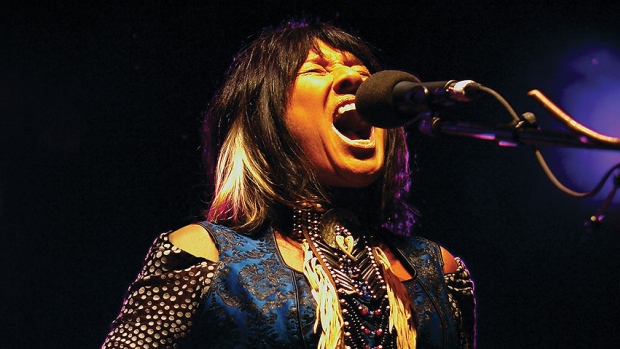
Buffy Sainte-Marie
The week before the festival, I was fortunate enough to hear Buffy Sainte-Marie perform in Midland in a small venue of about 300 people.  The audience was made up of  the young and old, women and men.  Buffy started strong and continued that way for 75 minutes.  She sang old songs and a brand new one.  She spoke from the heart, from her truth and smiled her beautiful smile.  But once she started to sing, I noticed that a lot of the women, including myself, were singing along with her.  We knew all the words.  When she sang the words from powwow songs with a voice strong and pure, we sang right along feeling just as strong.  I can’t remember ever being in an audience where the women’s voices were the ones that you heard – where women sang from their depths with free voices.  Buffy gave us all permission to do that just by being herself.  The young women wore Buffy t-shirts, the older women stood a little taller, felt a lot stronger and proud to be women.  We left the concert empowered.

That is the power of music.  It creates a collective space where we can gather, united and feel safe, feel like ourselves, express emotions that we keep inside most of the time and experience community.  I will always remember singing Starwalker along with Buffy Sainte-Marie, singing Hallelujah with the people at Mariposa and being held and lifted up by Matt Anderson`s Feel Like Going Home.  These are the experiences that enrich my life, that feed my spirit and that keep me going. They become part of my story. But these are not just my stories.  They are the stories of all the people I shared them with.  We are now a part of each other stories.  We are always building new stories and those stories will define who we are and who we become.  That is the power of stories.


Richard Wagamese
And so I'd like to end with a quote from one of my favourite storytellers, Richard Wagamese who also passed away this year.  This is from his last book Embers (p. 46) "This human family we are part of, this singular voice that is the accumulations of all voices raised together in praise of all Creation, this one heartbeat, this one drum, this one immaculate love that put us here together so that we could learn its primary teaching -- that love is the energy of Creation, that it takes love to create love." 

Tuesday, 4 July 2017

Looking Towards the Next 150

Here are some stories of hope and healing that happened alongside the more traditional Canada 150 celebrations.

Along the Healing Path
Just down the street from us in Waubaushene, ON a new mural was unveiled on the Tay Trail.  The mural is titled Nikeyaa noojimowin miikanaans or Along the Healing Path.  Designed by Midland art student, Richelle Chartrand McCue and painted with her fellow high school students, the mural is a response to the Truth and Reconciliation process that Canadians are currently engaged in.  McCue is Indigenous and the project inspired her to learn more about her culture.  The animals in the mural represent the Seven Grandfather teachings  which are Humility (wolf), Bravery (bear), Honesty (Sabe), Wisdom (beaver), Truth (turtle), Respect (buffalo) and Love (eagle).

Nikeyaa noojimowin miikanaans, Along the Healing Path
  
The township and local businesses provided the funds for materials and installation.  The mural is on the Tay Trail where hundreds of people can view it as they cycle, walk and run along this lakeside path.  We are so honoured to have this beautiful reminder of healing at the end of our street.  The times we have stood and looked at it or read the comprehensive information plaque near the trail, people have stopped to look at it as well and quite a few conversations have ensued so far.

You can view a CTV news video about this project here and see the students creating the project.  The township wanted a mural, the school said yes, an art teacher suggested the theme of Truth and Reconciliation, the students did the work and the community provided the funds and now all the residents and visitors to the area can be a part of the story as well.  

Medicine Wheel, the Bear and the Voice of a Nation
Another local Midland artist Paul Whittam who signs his work with his Anishinaabeg name Negik (Star Otter) created an inclusive art project in Toronto for Canada Day.  He returned to the city of his birth for this project.  Although Paul was taken from his family in the Sixties Scoop, he has reconnected with his birth family and not only expresses Anishinaabeg culture in his artwork but he also spends time teaching young people about this culture.

The initial mural that Negik brought to Toronto

So on July 1st he took the beginnings of a 4 x 8 foot acrylic canvas to Thompson Memorial Park in Toronto and invited the public to add to it using their hand prints.  The piece is called "Medicine wheel, the Bear and the Voice of a Nation". 


Medicine Wheel, the Bear and the Voice of a Nation with artist Negik
on the right when the mural was completed.


Here are some photos from his facebook page of visitors to the mural. You can view more of Negik’s beautiful art on his facebook page.


Voice from the Teepee
If you were following the Canada 150 story in Ottawa, you may have heard about people erecting a teepee on Parliament Hill.  After the RCMP tried to take it down, through negotiations it was moved to a different location near to the stage. 
Trudeau leaves teepee (photo: MacLeans)
 On Canada Day, PM Justin Trudeau and Sofie Gregoire Trudeau spent time sitting with the occupants in the teepee but Trudeau didn`t say what was discussed inside to the media.  So if you are curious to know what the teepee was all about, here is a short video  to explain it from the occupants side.
Sarain Fox  (photo sarainfox.com)
“The teepee is a symbol of the reoccupation of Canada.  What I want people to know as we approach Canada 150 is that the reoccupation of Canada is just one way that we are changing the narrative for the next 150 years,” says Sarain Fox, Anishinaabe professional dancer, choreographer and actor. Sarain’s voice is an important one to listen to.  It is part of our new narrative and listening to each other is one of the main foundations of reconciliation.
I was curious to know more about this well spoken, clear, young woman so I googled her and found her website.   There I found a 9 minute video called Sarain Winneway Short (watch it here)  which documents Sarain’s trip to the community of Winneway First Nation in Quebec to give dance workshops for the kids of all ages in the community.  The video is very hopeful as she works with the kids to explore movement, dance, healthy living, traditional strengths such as the circle and working together. The kids respond to her enthusiasm and skill and participate in performing for their community.  This video will bring a smile to your face.
Kids in Winneway First Nation watch their classmates perform with Sarain Fox behind them

All of these young artists are well aware of the harm that has been done in the past and they are using their art to create new stories for all of our children and grandchildren.  They are confronting the truth and finding a healing path forward.  Their artistic gifts and voices are ones we can learn from and be inspired by as we all move along this healing path together.

Tuesday, 27 June 2017

Like Magic


Separated from the earth by cement
Separated from the sky by steel and concrete
The buses roar into the terminal
Where I wait.

A thin line of blue sky is visible
Between the roof and the road
I glimpse cars racing along the Allen 
And hear subway trains rattling into the station

If I was to take a deep breath
And from this I refrain instinctively
I would smell the exhaust that
Bellows out from all the machines

One green GO bus idly rumbles at rest in its bay
While another growls, toots its horn and exits
Over and over, even the sounds of cars and trains
Are drowned out by the noise of roaring bus engines


Then suddenly,
into this inhospitable, mechanical
Vehicular, hard, grey environment
Fly two small, brown sparrows

Landing, they hop along the concrete
Searching for crumbs, food dropped
Nutrition in the forgotten, the trampled
They twitter to each other

And I find myself smiling at them
And saying hello there
Then chuckling with delight at their
Animated, musical conversation 

These two little, feathered balls of life
Transform the space like magic
And I feel alive once more
Connected, not cut off, from life.

Just like magic!

Tuesday, 20 June 2017

For Canada 150 Let's Celebrate New Partnerships

As Canada prepares to celebrate 150 years since confederation, I think we can use this anniversary to celebrate the beginning of new partnerships between the people that have lived here for thousands of years and those who have come in the last 400.  They are being created all over this country.  People aren’t waiting for the government to begin the process.  Instead they are leading the way.  Here are three such partnerships.

Classroom Buddies
I recently heard a CBC radio interview with  Lisa Howell, a teacher in Gatineau, PQ who uses a buddy program with seniors to work with her students. There are also many indigenous students in her class.  The seniors and students work together once a week on all kinds of projects. It gives the students the experience of elders and the seniors the experience of being with the youth.

   Teacher Lisa Howell (centre) and senior buddy Louis Comerton
chat with a student at Pierre Elliott Trudeau elementary
school in Gatineau. (Halima Sogbesan/CBC)

Recently, she taught the class about Jordan’s principle, residential schools and reconciliation.  Jordan's Principle  is used in Canada to resolve jurisdictional disputes about which government will provide services for First Nations children.  It was created after Jordan River Anderson, an indigenous child born with a complex medical condition, spent all 5 years of his short life in hospital because the provincial and federal governments fought over who would pay for his medical care at home.  In the radio interview, the teacher relates how her students felt when they learned about Jordan.  As the students worked with their  buddies, they told the seniors about Jordan’s Principle.  Many of the seniors had never heard about Jordan or residential schools and they learned about them from their young buddies. 

On another occasion, one senior went home and looked up the First Nation that some of the kids are from and came back to share that she now knew where they were from.  The kids were very happy to have their homes recognized.  This offers a new way of understanding Canada for the seniors and new partnerships of respect are being formed across ages and cultures.


Hockey Cares

 I recently got an email from the Gord Downie and Chanie Wenjack Fund letting me know that my earlier donation is being put to use.  The first recipient of a $5000 ReconciliACTION grant is Hockey Cares.  The email from co-chairs Mike Downey and Charlene  Bearhead goes on to say,
“With the help of this grant, young Indigenous hockey players from Attawapiskat, Ontario will be supported to take part in a hockey tournament to play on teams of combined Indigenous and non-Indigenous players in Oakville, Ontario.  Through this project, all players will make new cross-cultural connections, share their stories and learn from one another – cornerstones to our collective reconciliation journey.”

Hockey Cares participants from Attawapiskat

Springwater Park
In 2012, the Ontario government changed the status of Springwater Park, near Barrie, ON from operating to non-operating because of financial losses.  Some in the community decided to challenge this.  Two grassroots organizations, the Springwater Park Citizen’s Coalition and the Friends of Springwater tried to keep the park open.  But it was the women from Beausoleil First Nation who occupied the park throughout the spring, summer and fall of 2013 to bring attention to the fact that the park is on traditional Beausoleil First Nation territory who were successful.  Eventually a deal was struck between the First Nation and the Ontario government to keep the park open.  The five year deal between 2015 and 2019 gives the First Nation the responsibility to staff the park and increase revenue.

Some aspects of the park were taken away due to high maintenance cost such as the wild animal exhibits and playground equipment.  The park is for day use now with hiking trails, a large playing field, pond and picnic areas. Beausoleil First Nation is doing education programs with local schools at the site as well.

I was recently at Springwater Park for the Barrie Native Friendship Centre Pow Wow at which everyone is welcome.  It was wonderful to see the dancers from toddlers to grandparents dance in their beautiful regalia. The announcer explained what was going on, when pictures could be taken and when the dance was a ceremonial one in which pictures were not appropriate.  He added dances as they were requested and cracked jokes along the way.

“The Great Responsibility: The Throwing and the Catching
 of the Ball of Life” by Mary Lou Meiers printed on aluminum
and mounted on cedar

We also found that the 16 works of art in the Call to Action 83 project had been printed on sheets of aluminum which allow them to be displayed outside permanently.  We were looking at the first 5 when a staff member on a small motorized machine pulling a trailer stopped to talk.  He asked us if we knew about the art and we told him that we had been at the opening at the McLaren Art Centre.  He went on to tell us that he had used old cedar park benches to make the frames for the aluminum prints.  The weathered wood looked perfect with the bright paintings and spoke of the history of the park as well.  He had only managed to get 5 out that day because he was so busy with the pow wow but he pointed out the posts he had put in to hold all 16.  “The others are in the park office if you want to see them,” he added.

Painting number 4 by Negik, Star Otter
You can read his statement here

Curious to see what they looked like in their new form, we walked the short distance to the park office.  The staff member there was happy to let us in to see them.  She knew one of the artists, who had taught her daughter to paint.  She proudly pointed out one of her daughter’s paintings she had displayed in the office.  As we looked at the paintings and talked to the woman, we shared stories about the artists we knew and talked about how powerful the project was.  Initially, Steve, the man we met earlier will put all 16 out each day and take them down again in the evening to prevent vandalism.  They will be officially opened on June 21 which happens to be National Aboriginal Day.

It wasn’t until I came home that I researched more about this unique park partnership.  In an article  in Anishinabek News  the author writes, “Ontario and the Beausoleil First Nation have embarked on this journey to develop a relationship based on mutual respect, sharing and the principles of recognition and reconciliation.”

While I can't celebrate many aspects of the history of Canada, I can celebrate the wonderful people that are taking chances, showing courage and offering leadership in how we can move forward together.  These stories are everywhere if you start looking out for them.  We can celebrate our new story together on July 1st.